
Taking Kharg would give the US control over virtually all of Iran's oil exports and thus provide significant leverage, notes Prem Panicker in his must read daily blog on the Gulf War. It would also put American troops within range of Iran's remaining missiles, drones, and artillery on a piece of real estate that is just eight square miles in size, and just 15 miles from the Iranian mainland.

'In such a scenario, Iran could proclaim itself victor, rebuild, re-enforce its diminished regional proxies to further destabilise neighbouring nations and take control of the Persian Gulf and Strait of Hormuz.'

The United States has encouraged India to purchase Russian oil already at sea to mitigate supply shortages and price increases amid the West Asia conflict, according to Energy Secretary Chris Wright. This move is described as a short-term effort to stabilise the market without altering Washington's policy towards Russia.

Amid rising tensions in West Asia, China is urging all parties to cease military operations, following Trump's appeal for help in securing the Strait of Hormuz.

Delhi should keep all its options open in what is essentially a transitional period in the geopolitics of energy rather than remain a gatekeeper serving Trump's 'America First', suggests Ambasssador M K Bhadrakumar.

'We need to give Pakistan something serious to think about on its eastern front -- that is the only way to actually help Afghanistan right now.'

By appearing to privilege ideological affinity over strategic balance, India risks eroding the trust painstakingly built across West Asia. Once the perception takes hold that India's friendship is conditional and transactional, rebuilding credibility will be difficult, warns Amberish K Diwanji.

'The entire US ecosystem built over decades at the bases in the Gulf region, especially the UAE, costing trillions of dollars have been decimated, dealing a mortal blow to the US Central Command's war capability,' points out Ambassador M K Bhadrakumar.

Israel and the United States had a plan. Iran punched back. And now the Gulf is reeling, the world is beginning to feel the pain and, as on date, no one in Washington or Tel Aviv appears willing to admit that the punch has landed, notes Prem Panicker, continuing his must-read blog on the war in the Middle East.

Alliances fight wars effectively only when they share an endgame. If Israel acted without US knowledge, then the military alliance is operating without real coordination at the level of strategic targeting. Neither picture is reassuring in a war that is no longer regional in its consequences. Prem Panicker continues his must read daily blog on the Gulf War.

'China continues to perceive its relations with India through the prism of India-US relations, with the US using India to counter balance against China in the Indo-Pacific and beyond.'

'After the Galwan clash, the rules of engagement changed with the army commanders allowed to use any means at their disposal as they deem fit for tactical operations.'

Trump's outburst comes amid escalating tensions between the US and its northern neighbour, following recent remarks by Canadian Prime Minister Mark Carney at the World Economic Forum (WEF) in Davos.

Trump has repeatedly asserted that Greenland is important to safeguard the US from Russia and China's presence in the Arctic Ocean, and has demanded that the Kingdom of Denmark sell the self-governed territory.
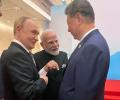
'One Chinese interlocutor said India should realise that "China can do without India, but India could not do without China", pointing to its inability to do without Chinese intermediates and components,' former foreign secretary Shyam Saran discovers on a visit to China.

The Chinese military on Monday started new major drills in the 'middle areas' of the Taiwan Strait amid rising diplomatic tensions with Japan over Taiwan that Beijing claims as its territory.

In the Indo-Pacific's new era -- where perception shapes reality faster than treaties -- the real entrapment is not of China or the United States. It is the test Japan has set for itself -- and whether partners like India, acting as balancers rather than accelerants, can help ensure that the story ends in stability, points out Varun Arya.

United States President Donald Trump on Saturday threatened to impose tariffs on Denmark and several European countries unless they agree to sell Greenland to the United States, framing the move as a national security imperative amid Chinese and Russian interest in the territory.

Spokesperson of the Ministry of Foreign Affairs of China, Lin Jian, said on Wednesday that China supports Iran in maintaining its stability, adding that Beijing has always opposed the interference in other countries' internal affairs and the use of force in international relations.

United States President Donald Trump reiterated the claims of having to do 'something' about Greenland, saying that if US doesn't take any action, Russia and China would spring in and that Washington, DC does not want to have them as neighbours.

China has imposed sanctions on 20 US defence firms in response to the Trump administration's approval of a record USD 11.1 billion arms sales package to Taiwan.
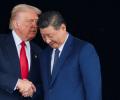
Speaking to reporters aboard Air Force One, Trump stated, "We have a deal," referring to the trade pact which will be routinely extended. "Every year we'll renegotiate the deal, but I think the deal will go on for a long time, long beyond the year. We'll negotiate at the end of the year," he added.

India emerged from the war militarily bruised and strategically altered. The United States, under the guise of friendship, had succeeded in achieving what open alignment never could: The psychological and political repositioning of India within the Cold War order, points out Dr Kumar.
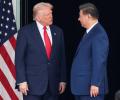
United States President Donald Trump said that China 'knows the consequences' if it attacks Taiwan, asserting that Chinese President Xi Jinping understands the situation 'very well'.

What appeared to be a generous act of friendship was, in truth, a manoeuvre within a much larger strategic game. The United States used the 1962 war not just to aid India but to test how far it could be pulled into the Western fold, points out Dr Kumar.
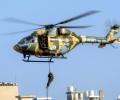
'The tools of warfare are changing. The MoD must deepen its engagement with technology thinkers that can present compelling visions of where warfare may be heading.'
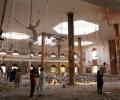
In 2025, India launched Operation Sindoor, a multi-domain combat mission against Pakistan in response to cross-border terrorism. The operation involved precision strikes, military retaliation, and diplomatic measures, marking a significant shift in India's security policy.

The US government, under President Trump, justifies the intervention as a security necessity rather than a resource grab. The primary official reasons include: narco-terrorism charges, national security and migration crisis.

US lawmakers have expressed concerns that policies enacted by the Trump administration, such as the H1B visa fee and tariffs on India, are detrimental to American businesses and threaten the relationship between the United States and India.

The enduring relationship between the two countries have survived the disintegration of the erstwhile USSR in 1991, the end of the Cold War and the regime change in both countries, points out Rup Narayan Das.
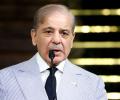
United States President Donald Trump is set to engage in high-stakes bilateral meetings on Thursday, including a closed-door session with Pakistan's Prime Minister Shehbaz Sharif in the Oval Office, according to Trump's public schedule released by the White House.

Trump also praised Chinese President as "a great leader of a great country" and said the two sides had "already agreed to a lot of things."
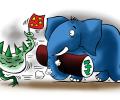
American sourcing firms and exporters in China are approaching Indian companies to supply goods to the US as high tariffs imposed by Washington are making it difficult for them to ship directly to America, apex exporters' body FIEO said on Monday. The US has imposed 145 per cent tariffs on Chinese goods entering the American market. For India, the duty is just 10 per cent.
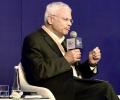
According to the Justice Department, Tellis, 64, the Tata Chair for Strategic Affairs and a senior fellow at the Carnegie Endowment think-tank, served as an unpaid senior adviser to the State Department and was also a contractor with the Office of Net Assessment at the Department of Defense.

United States President Donald Trump on Wednesday announced his upcoming diplomatic trip to Malaysia, South Korea, and Japan, highlighting a significant meeting with Chinese President Xi Jinping in South Korea.
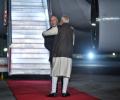
Russian President Vladimir Putin arrived in New Delhi for a two-day visit focused on strengthening ties with India, including defense cooperation and trade, amidst a changing geopolitical landscape.

'The longer India hangs out to dry, the worse the New Delhi-Washington relationship gets.'

China's ruling Communist Party is holding its annual leadership conclave to discuss the new five-year plan, the impact of US President Donald Trump's tariff war, and the ongoing anti-corruption crackdown in the military.
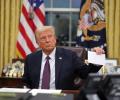
US President Donald Trump claimed India will stop buying oil from Russia, while also stating China will cut back substantially. He also discussed the conflict between India and Pakistan, reiterating his claim of helping settle the conflict.
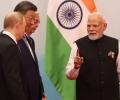
Russian Foreign Minister Sergei Lavrov on Thursday said the US threats of tariffs against India and China are failing and there is a growing understanding in Washington of the futility of talking in such language with two ancient civilisations.
 © 2026 Rediff.com - Advertise with us - Disclaimer - Privacy Policy - Sitemap - Feedback - About us - Terms of use - Grievances